
By Luke James
“I grew up in the '30s with an unemployed father.
He didn't riot. He got on his bike and looked for work, and he kept looking 'til he found it.”
Those are the infamous words of former Conservative Secretary for Employment (presumably someone was being ironic when they gave him that title) Norman Tebbit.
They are the words that inspire the latest generation of Conservatives who say they want to help people trapped in “ghettos of poverty” to move to find work.
The ghettos of poverty Iain Duncan Smith talks about are our communities, which now lack opportunities. The Tories solution to the poverty they are massively responsible for creating is now to try and destroy families and community, the glue that helps us through these tough times.
By ‘moving to work’ the Tories mean they want to see the same depopulation that helped destroy the Welsh language when people were lured, or forced, to move to work in Liverpool or London or even in Wales’ industrial cities.
What the Conservatives are engineering is a state where community is a commodity which can only be afforded by the well off and for the rest of us to be a transient population moving around the UK, with total disrespect for culture and language, in search of work.
The message the Conservatives want young people to hear loud and clear is that we have no right to expect to live near our family and friends, no right to continue living in the place we have been brought up and no right to expect to be able to find an affordable home there.
For many people that’s not a problem, it’s great to be able to ‘fly the nest’, perhaps for those of us who are lucky enough to go to university and then to some metropolis. But that dream becomes far less appealing when it is because of the hopelessness of your home not because of your ambitions.
It amazes me that the Conservatives can still claim to be the party of the family, purely based on their out dated views that the family is still mother, father and two point four children all under the same roof.
The Conservatives objection to the Welsh governments housing LCO earlier this year is also part of their agenda to smash community and create a roving population to serve to support the needs of the free market.
None of this is the ‘new politics’ David Cameron boasts of – to be fair at least Cameron hasn’t betrayed his party’s philosophy and purpose unlike Blair and New Labour.
In many ways I’m a conservative, I want to conserve my community, our nation, our culture and language and I won’t sit back and let it be destroyed so the shareholders of Capitalism PLC can reap the rewards.
So my suggestion, for now, how about we start making bikes for the Tories to get on or say cars, in Wales, and provide people with opportunities where they live. This isn’t a new idea, it is called sustainability, but the British parties are happy enough to just pay lip service to it.
As Dylan Thomas said ambition is critical, and it is but lets have ambition for ourselves, our communities and nation rather than allow a greedy few to tell us what’s good for the market is good for the people.
“Llifed dagrau'r gwangalon a llyfed y taeog y llawr
Er dued y fagddu o'n cwmpas, ry'n ni'n barod am doriad y wawr!”
“Let the faint-hearted keep wailing, let the serfs grovel and fawn
In spite of the darkness around us, we're ready to greet a new dawn.”
I for one am nobody's serf - bring on the referendum!
Tuesday, 29 June 2010


Monday, 28 June 2010
Ysgol Haf

Eto eleni mi fydd CymruX yn cymryd rhan blaenllaw yn Ysgol Haf Plaid Cymru ar y 9fed i’r 11eg o Orffennaf. Mae cyfleodd i ehangu ar addysg wleidyddol ac hyfforddiant ymgyrchu yn brin iawn yng Nghymru, felly mae’r penwythnos yn gyfle na ddylid ei golli.
Cost y penwythnos i aelodau o CymruX yw £25. Mi fydd CymruX hefyd yn rhoi bws yn rhad ac am ddim i deithio i Aberystwyth ac yn ôl. Ond cyntaf i’r Felin fydd hi felly brysiwch i archebu eich lle wrth ebostio post@plaidcymru.org.
Thursday, 10 June 2010
CymruX Letter in the Western Mail
CymruX once again has a presence in the Western Mail; Cerith Rhys Jones, non-portfolio officer on CymruX's NEC today writes about Trident:
"SIR – I was heartened to see a letter from the Chair of CymruX Young Plaid Cymru, of which I am a non-portfolio officer, in the Western Mail (June 7) regarding fairness, and to that, I would like to add my full support.
Also in that edition was an article about Trident. It was said that my party’s parliamentary leader Elfyn Llwyd MP had commented that Trident should come into the Strategic Defence Review (“Plaid joins the call for ‘outdated’ Trident’s future to be scrutinised”).
While I agree with that, I find myself agreeing with Parliament’s only Green Party MP Caroline Lucas, who more or less called for the abandonment of the nuclear defence system.
We live in the modern world, and although terrorist threats are aplenty, is it not right to say that the world would be a safer place if we all said “actually, we don’t need these weapons, Let’s find a solution to our differences by diplomatic means”? There is no use in threatening other nations with our nukes, while all the while condemning countries like Iran for theirs.
I find the Liberal Democrats’ comments most interesting. The newly created lord, Mike German, former Deputy First Minister, noted that we should first take stock, before rushing into any decisions. How bizarre, considering the new Deputy Prime Minister was keen for us all to know that his party was anti-Trident in the election run-up.
The Lib Dem Welsh spokesperson, however, seemed to think that his party didn’t support a like-for-like replacement of Trident. Was it not the Lib Dem manifesto that said exactly that? I think so.
It seems to be, once again, that Plaid, the SNP and the Greens are the only truly progressive parties. I had hoped that Labour and the Lib Dems would join us three in some sort of an agreement to form a government after the election, but now I see that we’re better off out of it.
While Labour were happy to support it while in office and the ConDem government are happy to support it now, we progressives need to stand up for what is right, what is needed, what is moral: scrapping Trident.
We have bigger problems – the economy and climate change to name but two – other than shaking our ill-thought-of fists at the rest of the world.
CERITH RHYS-JONES
Non-portfolio Officer, CymruX Young Plaid"
"SIR – I was heartened to see a letter from the Chair of CymruX Young Plaid Cymru, of which I am a non-portfolio officer, in the Western Mail (June 7) regarding fairness, and to that, I would like to add my full support.
Also in that edition was an article about Trident. It was said that my party’s parliamentary leader Elfyn Llwyd MP had commented that Trident should come into the Strategic Defence Review (“Plaid joins the call for ‘outdated’ Trident’s future to be scrutinised”).
While I agree with that, I find myself agreeing with Parliament’s only Green Party MP Caroline Lucas, who more or less called for the abandonment of the nuclear defence system.
We live in the modern world, and although terrorist threats are aplenty, is it not right to say that the world would be a safer place if we all said “actually, we don’t need these weapons, Let’s find a solution to our differences by diplomatic means”? There is no use in threatening other nations with our nukes, while all the while condemning countries like Iran for theirs.
I find the Liberal Democrats’ comments most interesting. The newly created lord, Mike German, former Deputy First Minister, noted that we should first take stock, before rushing into any decisions. How bizarre, considering the new Deputy Prime Minister was keen for us all to know that his party was anti-Trident in the election run-up.
The Lib Dem Welsh spokesperson, however, seemed to think that his party didn’t support a like-for-like replacement of Trident. Was it not the Lib Dem manifesto that said exactly that? I think so.
It seems to be, once again, that Plaid, the SNP and the Greens are the only truly progressive parties. I had hoped that Labour and the Lib Dems would join us three in some sort of an agreement to form a government after the election, but now I see that we’re better off out of it.
While Labour were happy to support it while in office and the ConDem government are happy to support it now, we progressives need to stand up for what is right, what is needed, what is moral: scrapping Trident.
We have bigger problems – the economy and climate change to name but two – other than shaking our ill-thought-of fists at the rest of the world.
CERITH RHYS-JONES
Non-portfolio Officer, CymruX Young Plaid"
Wednesday, 9 June 2010
List Members
By Daniel Pryce Lawrence
A while ago, well about a year ago, after looking on the 100 Welsh Heroes website I decided to write a list of who I thought were the greatest 10 Welshmen and women of all time. It ended up being the 15 greatest (it was tough to narrow down), and unfortunately no women are featured in it, that is mainly due to fact that there is hardly any women on the list of the top 100, which I based my list on. I was going to do a new list in which the names Kate Roberts, Margaret Haig Thomas and Tanni Gery Thompson may have featured, but I thought for now I would stick with my earlier list and would ask for your opinions on that.
The reason I did the list was because I wanted to pick those great Welsh men and women who I thought had made the biggest contribution to Wales and the World. Personally, although I much admire the work of our sports stars, actors, musicians and singers I have missed them out of my list. The Tom Jones', Catherine Zeta Jones' and many other singers and actors for which Wales is famous are well known, and some of them do a great job representing Wales around the World. But in my list I wanted the scientists, thinkers and nation builders to be recognised, as I have always thought they do not receive the acclaim they deserve.
They were all born in Wales except David Lloyd George (born in Manchester), and King Arthur (no-one knows where he was born). But both have strong connections to Wales and I think can be considered Welsh for the purposes of my list. You could argue that Alfred Russell Wallace and Bertrand Russell were not Welsh, but as they were both born here (Bertrand Russell also died here), spent many years in the country and were aware of their questionable nationality I think they could be considered Welsh. There are many more people often claimed as Welsh who have far more tenuous links to the country.
Another list that I think would make interesting reading would be a list of those people of Welsh decent who have gone on to have a major impact on the World. The list would feature some of the greatest American presidents, such as Thomas Jefferson, John Adams and Abraham Lincoln, not to mention those with less illustrious careers such as Murray Humphrey's and Jesse James. But that list would prove even more tricky and is for another day.
I've always been a fan of these sort of lists, and I realise people will all have their own ideas about who our greatest heroes are. They are a bit of fun, but I also think they may (especially when voted on by the public) tell us something about what the people of Wales think is most important to them. After all, it is the standards set by our greatest heroes by which we all measure ourselves, and by which the world measures us.
So here they are, what do you think?
My Welsh Heroes:
1. Owain Glyndwr
2. David Lloyd George
3. Aneurin Bevan
4. Robert Owen
5. Gwynfor Evans
6. Bertrand Russell
7. Bishop William Morgan
8. Alfred Russell Wallace
9. Hwyel Dda
10. Llywelyn ab Iorwerth
11. Dr Richard Price
12. King Arthur
13. Gerald of Wales
14. Raymond Williams
15. Iolo Morganwg
Daniel Pryce Lawrence
South Wales East Representative
A while ago, well about a year ago, after looking on the 100 Welsh Heroes website I decided to write a list of who I thought were the greatest 10 Welshmen and women of all time. It ended up being the 15 greatest (it was tough to narrow down), and unfortunately no women are featured in it, that is mainly due to fact that there is hardly any women on the list of the top 100, which I based my list on. I was going to do a new list in which the names Kate Roberts, Margaret Haig Thomas and Tanni Gery Thompson may have featured, but I thought for now I would stick with my earlier list and would ask for your opinions on that.
The reason I did the list was because I wanted to pick those great Welsh men and women who I thought had made the biggest contribution to Wales and the World. Personally, although I much admire the work of our sports stars, actors, musicians and singers I have missed them out of my list. The Tom Jones', Catherine Zeta Jones' and many other singers and actors for which Wales is famous are well known, and some of them do a great job representing Wales around the World. But in my list I wanted the scientists, thinkers and nation builders to be recognised, as I have always thought they do not receive the acclaim they deserve.
They were all born in Wales except David Lloyd George (born in Manchester), and King Arthur (no-one knows where he was born). But both have strong connections to Wales and I think can be considered Welsh for the purposes of my list. You could argue that Alfred Russell Wallace and Bertrand Russell were not Welsh, but as they were both born here (Bertrand Russell also died here), spent many years in the country and were aware of their questionable nationality I think they could be considered Welsh. There are many more people often claimed as Welsh who have far more tenuous links to the country.
Another list that I think would make interesting reading would be a list of those people of Welsh decent who have gone on to have a major impact on the World. The list would feature some of the greatest American presidents, such as Thomas Jefferson, John Adams and Abraham Lincoln, not to mention those with less illustrious careers such as Murray Humphrey's and Jesse James. But that list would prove even more tricky and is for another day.
I've always been a fan of these sort of lists, and I realise people will all have their own ideas about who our greatest heroes are. They are a bit of fun, but I also think they may (especially when voted on by the public) tell us something about what the people of Wales think is most important to them. After all, it is the standards set by our greatest heroes by which we all measure ourselves, and by which the world measures us.
So here they are, what do you think?
My Welsh Heroes:
1. Owain Glyndwr
2. David Lloyd George
3. Aneurin Bevan
4. Robert Owen
5. Gwynfor Evans
6. Bertrand Russell
7. Bishop William Morgan
8. Alfred Russell Wallace
9. Hwyel Dda
10. Llywelyn ab Iorwerth
11. Dr Richard Price
12. King Arthur
13. Gerald of Wales
14. Raymond Williams
15. Iolo Morganwg
Daniel Pryce Lawrence
South Wales East Representative
Sunday, 30 May 2010
Seremoni Cofio'r Rhyfel Cartref yng Nghatalonia
Rhyw fis yn ol cynhaliwyd Seremoni gan gangen Cymru X Caerdydd er mwyn cofio'r Rhyfel Cartref yn Sbaen. Cynhaliwyd y seremoni ar ddydd San Sior (nawddsant Catalonia) ym mharc Alexandria, Caerdydd ar bwys y gofeb i'r Rhyfel. Bwriad y seremoni oedd cofio effaith y rhyfel a'r blynyddoedd o unbennaeth creulon a ddilynodd y rhyfel, ond hefyd i gofio'r degau o filwyr Cymreig, y rhan fwyaf ohonynt o Gymoedd De Cymru, a aeth i frwydro gyda'r lluoedd rhyngwaldol. Cofiwyd y bu iddynt frwydro dros ryddid, heddwch a sosialaeth yn y rhyfel dyngedfennol hon yn erbyn ffasgaeth Franco.
Cyflwynwyd y seremoni gan Emyr Gruffydd, cadeirydd Cymru X Caerdydd. Fe gafwyd darlleniadau gan Llion Williams, Dan Lawrence, Sian Owen a Deian Timms, yn y Gymraeg, yn Saesneg, yn Sbaeneg ac yn y Gatalaneg. Gososdodd Lleu Williams rhosod a chennin pedr (blodau cenedlaethol Catalonia a Chymru) ger y gofeb. Diolch i bob un a ddaeth i wneud y seremoni yn un llwyddianus.
* * * * * * * * * * * * * * * * * * * *
Last month on St. Geroge's day, the Catalan national day, Cymru X Caerdydd held a ceremony in order to remember the contribution of the Welsh soldiers who went to fight in the international brigades. Thank you to all who came to make the ceremony a success.

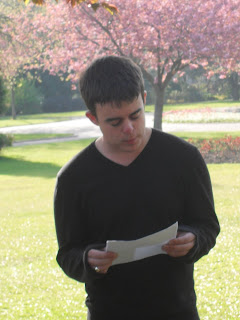


Cyflwynwyd y seremoni gan Emyr Gruffydd, cadeirydd Cymru X Caerdydd. Fe gafwyd darlleniadau gan Llion Williams, Dan Lawrence, Sian Owen a Deian Timms, yn y Gymraeg, yn Saesneg, yn Sbaeneg ac yn y Gatalaneg. Gososdodd Lleu Williams rhosod a chennin pedr (blodau cenedlaethol Catalonia a Chymru) ger y gofeb. Diolch i bob un a ddaeth i wneud y seremoni yn un llwyddianus.
* * * * * * * * * * * * * * * * * * * *
Last month on St. Geroge's day, the Catalan national day, Cymru X Caerdydd held a ceremony in order to remember the contribution of the Welsh soldiers who went to fight in the international brigades. Thank you to all who came to make the ceremony a success.


Monday, 24 May 2010
At least it's not the end of the world
Guest blog by Luke Nicholas
Enough dust has settled and enough stock has been taken, in terms of Plaid's Westminster election performance, that we can now move on. And in doing so, we should completely reject the idea that somehow Plaid was slaughtered or massacred at the election. This doesn't mean adopting complacency or spinning the result as a good one, but it means recognising that we retained 3 members of Parliament. Not very good, but not the end of the world. I know that Cymru X members threw themselves into the campaign. In all of the target seats young people were heavily involved. Away from the targets, it was young people that ran Chris Williams' campaign in Cardiff Central. Not an earth-shattering result, but where better for the next generation of nationalists to learn their trade than at the coalface?
We held 3 seats. We wanted more, but quite simply, not enough people decided to vote for us. The real problem isn't Plaid's loss in not having a stronger team at Westminster. The real losers are the people of Wales who will now suffer disproportionately from savage public spending cuts. Empirically, you could conclude that a larger group of Plaid MPs would have made disproportionate cuts to Welsh public finances less likely, because the likelihood of us getting reform of the Barnett formula would have been considerably higher. A larger group of Plaid MPs would have saved jobs and protected services.
The question also has to be asked, can young nationalists still hold their heads high, having failed at the ballot box so recently? I believe we can. It is not our party that is responsible for these devastating cuts. We maintained all along that you have to create better economic conditions before you reduce the deficit. We put those arguments forward and most of the people of Wales decided to reject them. That is their democratic shoice. Most people in Wales didn't want a Plaid MP this time around. We'll have to keep trying.
In Scotland the benefits of more people voting for nationalist MPs are starkly obvious. They are not only getting less cuts, but are receiving a small proportion of the fossil fuels levy. This is the first time in history that Scotland is being directly paid for the exploitation of its own resources. It represents a significant break with traditional imperial policy. In Wales all such resources have long been extracted, but it is a well-established fact that if fairness is adopted as the principle for financing the nations and regions of the UK, Wales would be due far more in funding through the Barnett formula. I do not see this as a contradiction to the long-term aim of independence, which is not possible without a period of national development similar to that which the liberation movements on the African continent used to advocate before they mostly turned to globalisation and post-colonial malaise.
On one of the shelves in Ty Gwynfor is a stack of tea-coloured pamphlets from the "Plaid Cymru Commission of Inquiry, 1981". The guys that wrote those pamphlets really were up against it. At the time, the people of Wales had exercised their right to self-determination and had resoundingly turned self-government down. Plaid faced an existential crisis and the Commission of Inquiry was a fundamental, wide-ranging and incisive examination of the party's nature, organisation, policies and future.
I've been reading the report from the inquiry and the intelligence, attention to detail and excitement in terms of proposals is breathtaking. But at the same time there is a sense of disenchantment with the likelihood of getting a resolution to the national question, of making any step towards freedom, and of seeing what they called "community socialism" ever being put into practice. Like I said, they were up against it. One passage even declares that the only forseeable way Wales could ever gain even a limited measure of self-government would be in a revolutionary situation!
A few decades on and much of what they are asking for is now reality. So Plaid flatlined on 3 MPs a couple of weeks ago. But we're in government in the Assembly. Plaid's Assembly group has steered a positive course. Further self-rule is very much on the agenda. People outside of Plaid are prepared to openly discuss fiscal autonomy as a possibility within the next decade. The people of Wales, not Plaid, will ultimately decide on these things, but we are in as strong a position as we deserve in terms of being able to argue for incremental progress and eventually national liberation.
There's alot to be learned from what the likes of Dr. Phil Williams were talking about in the pamphlet. And in learning those lessons we can also look to a national future that is more optimistic than anything nationalists in 1981 would dare to dream of. And young people have a duty to the 1981ers to fulfil this task, because it's only because of the grumpy 1981ers that our party still exists today.
We shall overcome!
Enough dust has settled and enough stock has been taken, in terms of Plaid's Westminster election performance, that we can now move on. And in doing so, we should completely reject the idea that somehow Plaid was slaughtered or massacred at the election. This doesn't mean adopting complacency or spinning the result as a good one, but it means recognising that we retained 3 members of Parliament. Not very good, but not the end of the world. I know that Cymru X members threw themselves into the campaign. In all of the target seats young people were heavily involved. Away from the targets, it was young people that ran Chris Williams' campaign in Cardiff Central. Not an earth-shattering result, but where better for the next generation of nationalists to learn their trade than at the coalface?
We held 3 seats. We wanted more, but quite simply, not enough people decided to vote for us. The real problem isn't Plaid's loss in not having a stronger team at Westminster. The real losers are the people of Wales who will now suffer disproportionately from savage public spending cuts. Empirically, you could conclude that a larger group of Plaid MPs would have made disproportionate cuts to Welsh public finances less likely, because the likelihood of us getting reform of the Barnett formula would have been considerably higher. A larger group of Plaid MPs would have saved jobs and protected services.
The question also has to be asked, can young nationalists still hold their heads high, having failed at the ballot box so recently? I believe we can. It is not our party that is responsible for these devastating cuts. We maintained all along that you have to create better economic conditions before you reduce the deficit. We put those arguments forward and most of the people of Wales decided to reject them. That is their democratic shoice. Most people in Wales didn't want a Plaid MP this time around. We'll have to keep trying.
In Scotland the benefits of more people voting for nationalist MPs are starkly obvious. They are not only getting less cuts, but are receiving a small proportion of the fossil fuels levy. This is the first time in history that Scotland is being directly paid for the exploitation of its own resources. It represents a significant break with traditional imperial policy. In Wales all such resources have long been extracted, but it is a well-established fact that if fairness is adopted as the principle for financing the nations and regions of the UK, Wales would be due far more in funding through the Barnett formula. I do not see this as a contradiction to the long-term aim of independence, which is not possible without a period of national development similar to that which the liberation movements on the African continent used to advocate before they mostly turned to globalisation and post-colonial malaise.
On one of the shelves in Ty Gwynfor is a stack of tea-coloured pamphlets from the "Plaid Cymru Commission of Inquiry, 1981". The guys that wrote those pamphlets really were up against it. At the time, the people of Wales had exercised their right to self-determination and had resoundingly turned self-government down. Plaid faced an existential crisis and the Commission of Inquiry was a fundamental, wide-ranging and incisive examination of the party's nature, organisation, policies and future.
I've been reading the report from the inquiry and the intelligence, attention to detail and excitement in terms of proposals is breathtaking. But at the same time there is a sense of disenchantment with the likelihood of getting a resolution to the national question, of making any step towards freedom, and of seeing what they called "community socialism" ever being put into practice. Like I said, they were up against it. One passage even declares that the only forseeable way Wales could ever gain even a limited measure of self-government would be in a revolutionary situation!
A few decades on and much of what they are asking for is now reality. So Plaid flatlined on 3 MPs a couple of weeks ago. But we're in government in the Assembly. Plaid's Assembly group has steered a positive course. Further self-rule is very much on the agenda. People outside of Plaid are prepared to openly discuss fiscal autonomy as a possibility within the next decade. The people of Wales, not Plaid, will ultimately decide on these things, but we are in as strong a position as we deserve in terms of being able to argue for incremental progress and eventually national liberation.
There's alot to be learned from what the likes of Dr. Phil Williams were talking about in the pamphlet. And in learning those lessons we can also look to a national future that is more optimistic than anything nationalists in 1981 would dare to dream of. And young people have a duty to the 1981ers to fulfil this task, because it's only because of the grumpy 1981ers that our party still exists today.
We shall overcome!
Tuesday, 18 May 2010
Letter re: Welsh language
Below is a letter by Emyr Gruffyd which appears in today's Western Mail.
"SIR – I was rather disappointed to read some of Dr Sibani Roy’s comments (Letters, May 12). I am aware that Dr Roy is a well-respected councillor for the party and works hard, especially on the issue of ethnic minority community cohesion.
However, I could not help noticing that she had fundamentally misunderstood many of Plaid Cymru’s policies on the Welsh language.
Plaid policy does not in any way advocate forcing people to learn the language to obtain employment, as Dr Roy seems to be suggesting. However, she must realise that many jobs in the public sector in North Wales ask for a qualification in Welsh as it is a region where the language is widely spoken, and a language of preference for a large proportion of the population.
As she herself will know, Plaid is strongly in favour of welcoming people of all backgrounds to settle into our communities, while at the same time increasing opportunities for people to use the Welsh language in all aspects of life, especially in the workplace and in business.
Dr Roy is also mistaken in suggesting that language policy is the cause of Plaid’s mediocre performance in the General Election; our share of the vote increased greatly in English-speaking constituencies such as Rhondda and Cynon Valley, while it suffered in the Welsh-speaking heartlands.
Dr Roy must realise that Plaid has been the only party that has cared and fought for the interests of the Welsh language since its establishment in 1925.
Unlike the Labour Party, which has thrown all its socialist principles out of the window, Plaid Cymru will never forget our core commitment to ensuring that the Welsh language is given the respect and the attention that it deserves.
EMYR GRUFFYDD
Chairman of Cardiff Cymru X – Young Plaid Ifanc"
"SIR – I was rather disappointed to read some of Dr Sibani Roy’s comments (Letters, May 12). I am aware that Dr Roy is a well-respected councillor for the party and works hard, especially on the issue of ethnic minority community cohesion.
However, I could not help noticing that she had fundamentally misunderstood many of Plaid Cymru’s policies on the Welsh language.
Plaid policy does not in any way advocate forcing people to learn the language to obtain employment, as Dr Roy seems to be suggesting. However, she must realise that many jobs in the public sector in North Wales ask for a qualification in Welsh as it is a region where the language is widely spoken, and a language of preference for a large proportion of the population.
As she herself will know, Plaid is strongly in favour of welcoming people of all backgrounds to settle into our communities, while at the same time increasing opportunities for people to use the Welsh language in all aspects of life, especially in the workplace and in business.
Dr Roy is also mistaken in suggesting that language policy is the cause of Plaid’s mediocre performance in the General Election; our share of the vote increased greatly in English-speaking constituencies such as Rhondda and Cynon Valley, while it suffered in the Welsh-speaking heartlands.
Dr Roy must realise that Plaid has been the only party that has cared and fought for the interests of the Welsh language since its establishment in 1925.
Unlike the Labour Party, which has thrown all its socialist principles out of the window, Plaid Cymru will never forget our core commitment to ensuring that the Welsh language is given the respect and the attention that it deserves.
EMYR GRUFFYDD
Chairman of Cardiff Cymru X – Young Plaid Ifanc"
Subscribe to:
Posts (Atom)


